A better judge won’t fix your evals. A world model will.
Findings from our first research paper, The Anatomy of a Blind Spot.
TL;DR: What a judge is shown matters more than which judge you use: a frontier model reading only the output loses to a mid-tier model given the world around it. And a judge without that world doesn’t just miss defects — fed back, its reports degrade the system they touch.
How do you build an eval you can trust?
If you’re running agents in production, you probably have some version of an eval loop: judges scoring traces, failures getting triaged, changes checked against a suite before they ship. More and more of that loop runs without a human in it. So the real question isn’t whether you have evals — it’s what it takes for a judge’s verdicts to deserve the authority you’ve given them.
Designing a judge comes down to two foundational choices: which judge you use, and what context you give it. Nearly all the effort goes into the first. Most research asks what the judge is; almost none asks what the judge sees. We built Hosho around the opposite conviction: a judge can only be trusted if it has a world model of the agent it grades — what was asked, what the agent did, and what its sources say.
We didn’t want to assert that; we wanted to measure it. So our first paper isolates the effect of what a judge sees on what it can catch: hold the judge fixed, vary only what it is allowed to know, run it across seven public benchmarks (e.g. RAGTruth, WMT-MQM, IFEval).
Three findings, none of them obvious
1. You cannot buy your way out with a better judge.
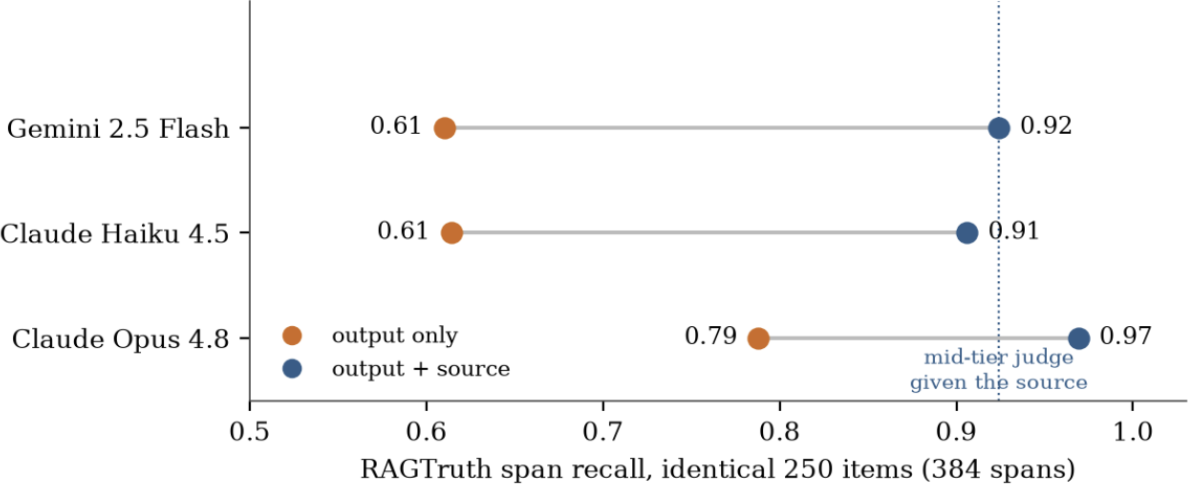
A frontier model judging from the output alone reaches 0.79 recall on human-annotated hallucination spans — below the 0.92 a mid-tier model reaches given the source. When your eval misses things, upgrading the model isn’t the fix; widening what the judge sees is.
2. The failures that matter most leave no trace in the output.
Grammar and formatting, an output-only judge catches fine. Omissions, contradicted claims, ignored constraints — the failures that matter in agentic work — it cannot see, and its miss rate rises in direct proportion to how much of the evidence sits elsewhere. False alarms are the other half: without the world, the judge flagged error-free outputs 2.5x as often — and a judge that flags four in five correct outputs is one your team stops reading. It isn’t more context that helps; it’s the right world: even a correct reference answer beside the real evidence made the judge worse — it started grading against the answer instead of checking the evidence.
3. An output-only judge’s feedback makes your system worse.
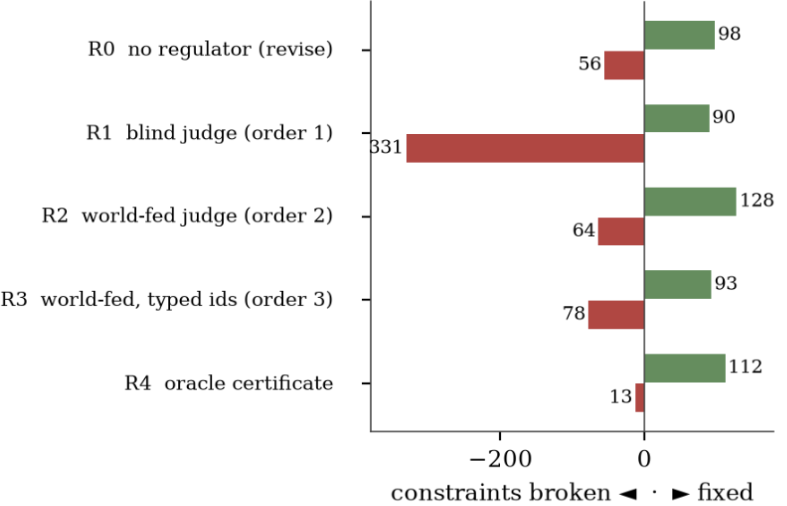
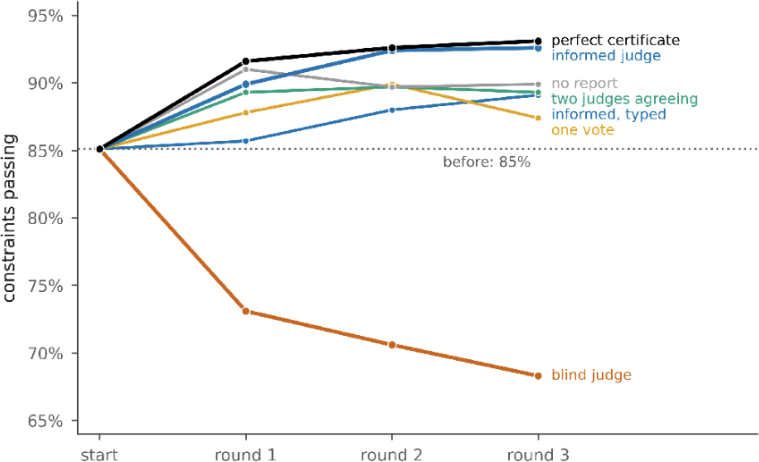
We fed each judge’s defect reports back to the model, let it revise, and scored every revision with code — no judge grading the repairs. Acting on the output-only judge’s reports left the system 17 points worse than no feedback at all: every false alarm became an edit, and edits break working behavior. What decided whether feedback helped was not how many real defects a judge found, but the precision of its reports. If your judge feeds a loop — retries, auto-fixes, regression gates — its precision decides whether you’re improving your product or injecting defects into it.
What an agent world model unlocks
Everything above points to one conclusion: reliable evaluation requires a world model of the agent — what was asked, what the agent did, and what its sources say. With it, a judge can do the two things that make an eval trustworthy: confirm a failure is real, and point toward why it happened. That’s the signal a team trusts enough to wire into its improvement loop; without it, the eval gets ignored — or followed down the wrong path.
This is what the Hosho platform is built to do: assemble a complete world model of each of your agents and judge against it, so you get eval signal you can trust and fixes you can act on.
For the research-minded
The paper is in the process of being published, and will be released alongside the harness and the full prediction ledger — failures included. We’re happy to discuss this work, share the harness, or hear what you’re working on: nitish@hoshoai.com